Eric Yde
Marshall J. Seidman Research Fellow
Harvard Medical School
Department of Health Care Policy
Email: eric_yde at hms.harvard.edu
I am a Marshall J. Seidman Research Fellow in the Department of Health Care Policy at Harvard Medical School. In July 2027, I will join the economics department at Pennsylvania State University as an assistant professor.
My research interests are in empirical industrial organization and the economics of healthcare markets. My current projects study how competition and regulations shape the prescription drug supply chain.
I received my PhD in Economics from the University of Virginia, and a B.A. in Economics from the University of Rochester.

WORKING PAPERS AND PUBLICATIONS
Vertical Integration and Regulated Profits in Pharmacy Benefits Markets (Job Market Paper)
Note: section 3 of this paper has been subsumed by Kakani, Yde, Kanter, Frank, and Bond (2026).
This paper studies the effects of vertical integration between insurers, pharmacy benefit managers (PBMs), and pharmacies on drug prices and insurance premiums. I construct an empirical model of pharmacy pricing, insurer premium setting, and consumer demand for insurance plans and pharmacies in Medicare Part D, a government program that provides subsidized drug insurance to older adults in the United States. I estimate the model using prescription drug claims data, which I combine with novel information on insurer-PBM relationships and pharmacy ownership. In equilibrium, vertically integrated insurers reduce premiums and increase internal prices for prescription fills, shifting profits to their pharmacies. Two institutional features motivate this profit-shifting strategy: consumer cost-sharing, which allows firms to retain profits on integrated prescription fills; and regulatory caps on insurer profits, which incentivize firms to "tunnel" excess profits to pharmacies through higher drug prices. My estimated model predicts that the divestiture of vertically integrated pharmacies would reduce drug prices by 7.3% and increase annual consumer surplus for Medicare enrollees by 8.1%.
Program Chair Award, American Society of Health Economists; Snavely Prize for Best Dissertation Proposal, UVA; Snavely Prize for Best Dissertation, UVA.

Profit Regulation and Strategic Transfer Pricing by Vertically Integrated Firms: Evidence from Health Care (with Pragya Kakani, Genevieve Kanter, Richard Frank, and Amelia Bond)
Note: this paper subsumes section 3 of my job market paper.
We provide evidence of strategic transfer pricing by vertically integrated health care firms in response to insurer profit regulations. Insurers increased prices at vertically integrated pharmacies by 9.5% following the introduction of caps on insurer profits in Medicare Part D. We detect larger price increases by insurers that were at greatest risk of exceeding the allowable profit level. More than one-fifth of these higher prices were borne by the federal government. Our analysis illustrates that vertically integrated firms can evade profit regulation by “tunneling” profits to unregulated subsidiaries, undermining regulatory intent and increasing health care spending.
Submitted.

The Effect of Price Caps on Advertising to Physicians: Evidence from the 340b Drug Pricing Program (with Sylvia Hristakeva and Julie Holland Mortimer)
Management Science (2026), 72(6):5361-5380.
We study the effect of price caps on the provision of costly effort by pharmaceutical firms using variation in drug discounts generated by a price regulation program that allows eligible hospitals to purchase outpatient drugs at steep discounts. These discounts directly affect drug manufacturers’ markups, and may change firms’ incentives to exert promotional effort targeted towards physicians at these hospitals. We find that the effects of price regulation on pharmaceutical firm effort depend crucially on the design of the regulations and the multi-product nature of pharmaceutical firms. Using detailed data on marketing payments from pharmaceutical firms to physicians, we observe that physicians receive 13% fewer promotional payments after their hospitals take up the program. The design of the price caps implies that discounts tend to increase with a drug’s age. Consistent with theoretical predictions, we find that pharmaceutical firms shift promotional payments away from older drugs and towards newer drugs, which are less affected by the price caps. For some drugs, this shift results in an increase in payments to physicians despite the price caps. Understanding these strategic, non-price adjustments is important for policymakers seeking to design effective regulations targeting specific products.
(SSRN version available here.)

Pharmacy benefit managers (PBMs) are third-party administrators of prescription drug programs for health insurance plans. They play a crucial role in the healthcare system by negotiating drug prices with pharmacies. Consequently, their payment structure can significantly affect the price of prescription drugs. I study the price effects of requiring PBMs and insurers to replace their default fixed-price contracts with cost-plus contracts. Using difference-in-differences methods, I find that Medicaid pre-rebate drug prices declined by an average of 17% in states that prohibited fixed-price contracting. The estimated price effects were driven by generic drugs, with slight increases in branded drug prices. These findings are consistent with cost-plus contracts reducing the ability of PBMs to profit off of asymmetric information regarding the true cost of drugs when negotiating compensation with insurers, but also inducing some PBM moral hazard by removing their profit incentives to contain costs. I also detect larger price decreases in states that rely more heavily on insurers that are not vertically integrated with a PBM. In markets where PBMs have strong informational advantages over non-integrated insurers, cost-plus contracts may be an effective means of reducing drug spending
Snavely Prize for Best Second Year Paper, UVA.
Invited presentations: ASSA Annual Meeting (Health Economics Research Organization Session).

Strategic Procurement and Drug Diversion in the Wholesale Prescription Opioid Market (with Ashwin Nair)
Submitted.
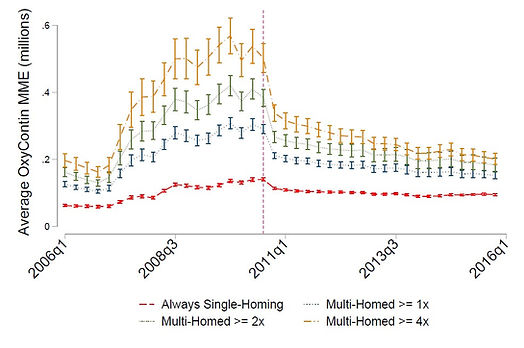
We study the strategic procurement and diversion of prescription opioids to illicit users by pharmacies using granular data on wholesale purchases. The government outsources monitoring for diversion to intermediary drug distributors. However, distributors cannot observe rival distributors' sales, incentivizing pharmacies engaged in diversion to contract with multiple distributors to avoid detection. Leveraging the introduction of an abuse-deterrent reformulation of OxyContin as a negative demand shock to the illicit market, we estimate that at least 24% of the OxyContin procured by multi-homing pharmacies was diverted to illicit users. Our findings highlight the risks of delegating monitoring to intermediaries with incomplete information.
WORKS IN PROGRESS
Hospital Influence on Physician Prescribing Decisions: Evidence from the 340b Program (with Maura Coughlin, Sylvia Hristakeva, and Julie Holland Mortimer)
This paper uses administrative data from Medicare to examine whether hospitals attempt to influence the pharmaceutical treatment decisions of their employed physicians in order to profit from the 340b Drug Pricing Program.
Price Effects of Retail Pharmacy Mergers in the United States
This paper conducts a retrospective analysis of mergers in the retail pharmacy industry using a novel dataset on over 200 acquisitions involving over 4,000 unique pharmacies. I use a structural model of bargaining between pharmacies and PBMs to decompose the price effects of pharmacy mergers.
Does Common Subcontracting Soften Competition? Evidence from Medicare Advantage
Many insurance companies subcontract with the same vendors. Policymakers and market participants have voiced concerns that common subcontracting may provide a means for insurers to collude. Using novel data on all subcontractors used by Medicare Advantage insurers for a long panel, I study how the overlapping use of subcontractors affects firm behavior.